Keyless Multi-Environment CI/CD on GCP
Build once to Artifact Registry for GKE and Cloud Run, promote the same image through dev/staging/prod, coordinate Firebase artifacts under the same release, and replace JSON keys with Workload Identity Federation.
Technologies
- Google Cloud Platform
- GitHub Actions
- Artifact Registry
- Workload Identity Federation
- GKE
- Kubernetes
- Kustomize
- Cloud Run
- Firebase
- Docker
- IAM
Key Achievements
- Promoted one versioned artifact through development, staging, and production
- Shared Kustomize bases with service and environment overlays instead of copied manifests
- GitHub Actions reaches GCP through Workload Identity Federation — no service-account keys in secrets
Project Links
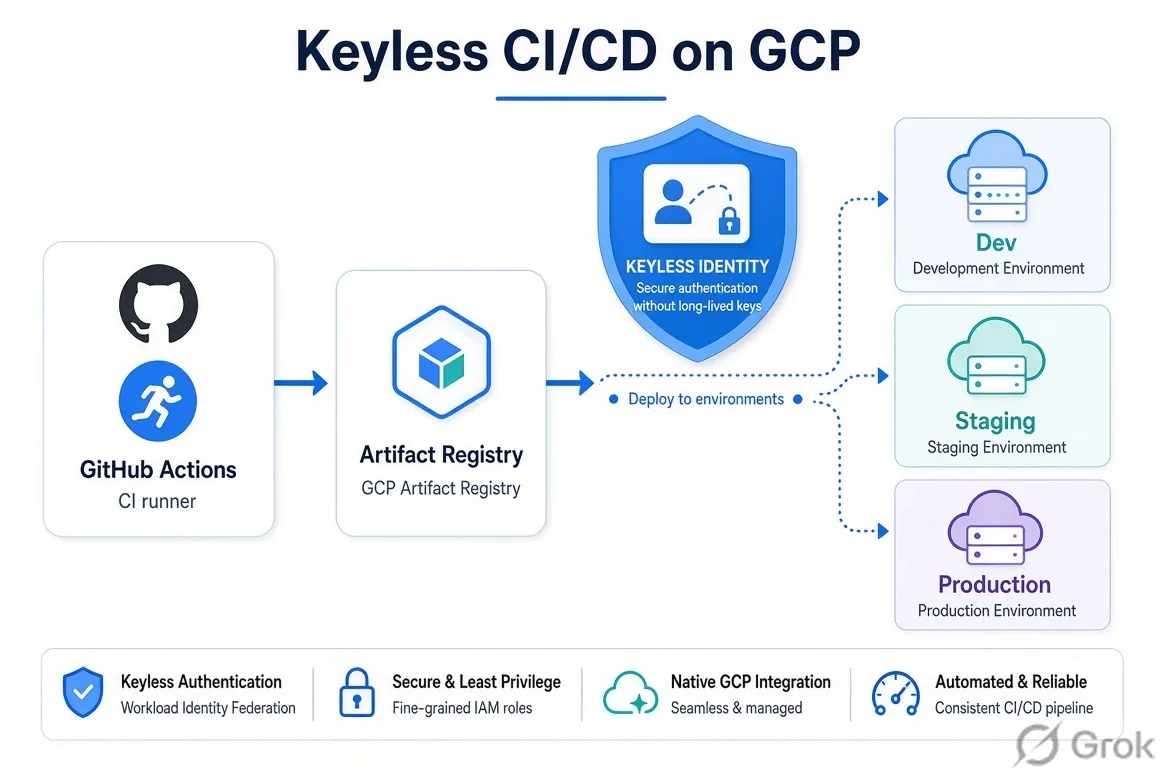
This is the delivery path for the Zimi GCP platform: GitHub Actions builds a versioned image once, stores it in Artifact Registry, and promotes that same digest through development, staging, and production for GKE and Cloud Run. Firebase Hosting and Functions use their own release artifacts and deployment toolchain. Kubernetes config is composed with Kustomize. GitHub and GKE authenticate to GCP with Workload Identity Federation, not JSON keys.
Rebuilds, copied YAML, and keys in the cluster
Building separately for each environment looks convenient until something fails only in production. The git SHA might match; the image often does not. Different build times, different caches, different unnoticed Dockerfile changes.
Kubernetes had a quieter form of the same drift. Each service and environment carried its own copy of probes, labels, ports, and resources. A one-line fix became a scavenger hunt. Intentional prod-only differences were hard to tell from accidents.
Credentials were the third copy. Service-account keys in GitHub secrets and keys mounted into pods are long-lived, easy to over-scope, and painful to rotate. Anyone who has the file has the access.
What changed
Main-branch CI builds one versioned container image and publishes it to a shared Artifact Registry. GKE and Cloud Run promote that digest through development, staging, and production instead of rebuilding it. Firebase is a separate path tied to the same source revision and release: Hosting deploys built directory contents, while Functions are packaged and built through the Firebase toolchain.
Kubernetes manifests are layered:
- A base for the common shape: resources, labels, probes, ports.
- A service overlay for things that belong to one app.
- An environment overlay for dev, staging, or production.
CI renders the selected composition to plain YAML and deploys that. The override is visible in git; the rendered output can be reviewed before it hits the cluster.
GitHub Actions presents its OIDC identity to GCP and receives short-lived credentials. IAM bindings constrain which repository, branch, and workflow can assume the deployer identity, and what that identity may do: push images, read config, deploy to the intended project.
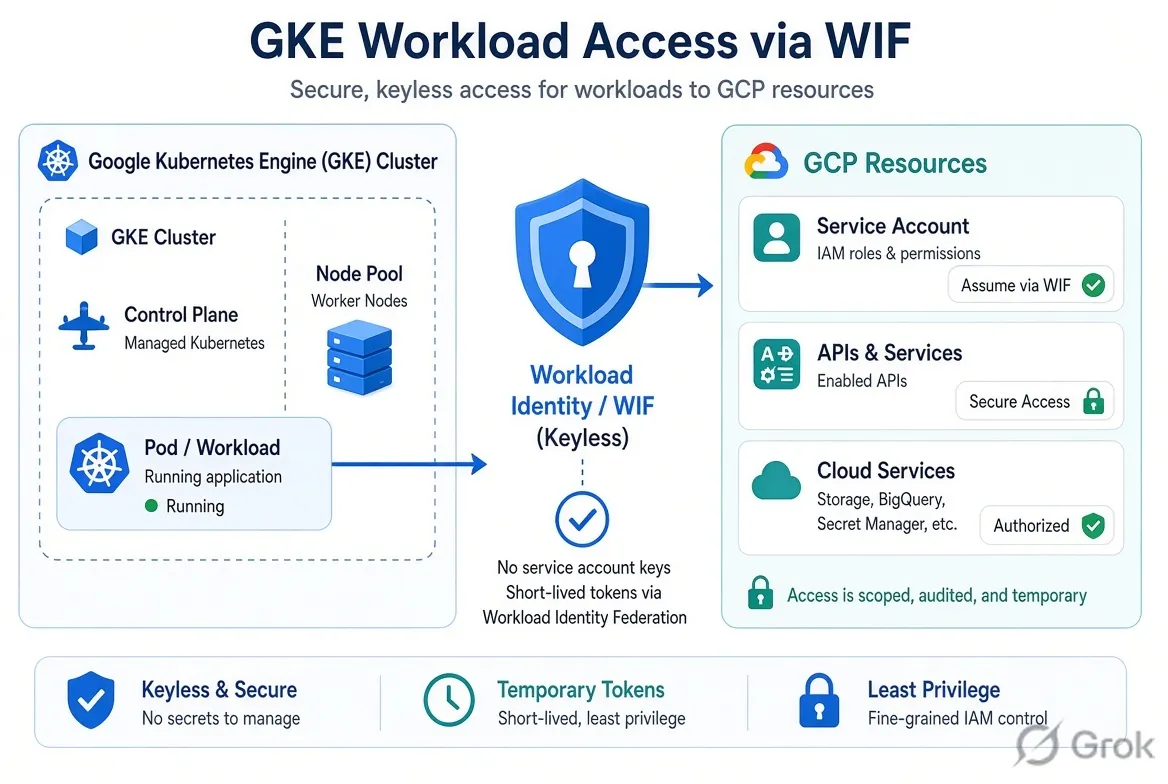
GKE workloads dropped mounted key files. A Kubernetes service account is bound to a GCP identity; the pod gets short-lived tokens at runtime and only the IAM roles of that identity.
Why federation instead of JSON keys
A JSON key works from anywhere that holds it: a laptop, a fork, a log line. Federation ties access to an attested workload identity. The token expires. The condition can say “only this workflow on main,” which is a much smaller accident surface than “anyone with gcp-sa.json.”
The same rule at runtime: the pod should not know where a secret file was mounted. Application code uses ADC; GCP decides whether that GKE service account may read the bucket or publish to Pub/Sub.
The trade-off is setup cost. Federation needs a pool, provider, attribute mapping, and IAM conditions — more moving parts than pasting a key into GitHub. It is also much easier to reason about six months later, when nobody wants to be the person who rotates twenty keys.
After
Environments promote an immutable artifact instead of rebuilding it. Kubernetes differences live in overlays. GitHub Actions and GKE workloads talk to GCP without long-lived keys in the repo or the cluster.
The coordinated release covers Kubernetes and Cloud Run with the promoted container digest, and Firebase with separately built deployment artifacts. Every production deploy traces back to the same source revision and release; only GKE and Cloud Run trace to the shared Artifact Registry digest.
Related: production deployment in the C4 model.